Current Status & The Hunt for a Counterexample
As of today, the FLRP remains unsolved. It stands as one of the most significant open problems in universal algebra.
The Prevailing Conjecture
The general consensus among experts is that the answer to the FLRP is no: there exists at least one finite lattice that cannot be represented as the congruence lattice of any finite algebra. This belief is fueled by the decades-long failure to find a general proof and by the difficulty of constructing representations for even moderately complex lattices.
Major Obstacles
- Finiteness is tricky. We lack a deep understanding of how the constraint of a finite universe restricts the structure of a congruence lattice.
- Constructions are hard. Methods for building algebras with a prescribed congruence lattice often produce infinite algebras.
- Group theory is hard. The Pálfy–Pudlák equivalence translates the FLRP into an equally challenging problem about intervals in subgroup lattices of finite groups.
The Seven-Element Frontier Is Closed
For fourteen years the search for a counterexample focused on a single seven-element lattice.
The L7 lattice, representable since 2026
Every lattice with at most seven elements was known to be representable except one, the seven-element lattice L7 identified in William DeMeo's 2012 thesis.
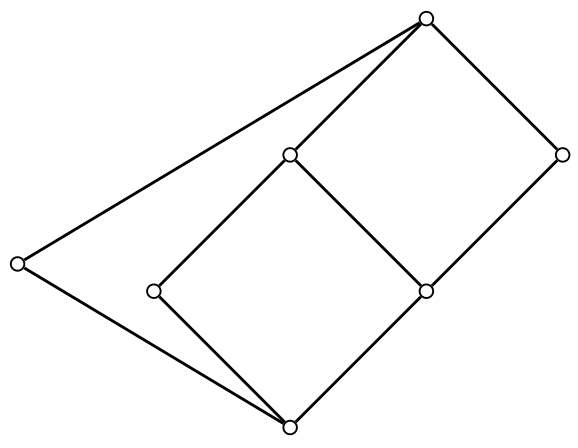
- In 2026, Chenxiao Tian showed that L7 is an interval in the subgroup lattice of \(\mathrm{PSL}(2, 64)\), and a scan of the tables of marks found a second representation, in \(\mathrm{Sp}(6, 2)\) at a smaller index. Both are verified in GAP, and the write-up is in preparation.
- Every lattice with at most seven elements is therefore representable.
- The census frontier is now the 222 lattices with eight elements, and the smallest height-two lattice with no known representation is \(M_{16}\).
Where the Search Stands Now
The search is no longer aimed at a single candidate lattice. The strategy described under Current & Future Research looks instead for a finite family of group-theoretic properties, each forced by some lattice shape, that no finite group can have simultaneously; by a theorem proved in Interval enforceable properties of finite groups, such a family would settle the problem negatively without naming a counterexample in advance. The smallest lattices that strategy would have used, the hexagon and its seven-element relatives, are now known to be representable in almost simple groups, so any contradiction must come from larger shapes or finer invariants. See the plan.